Table of Contents
- Key Takeaways
- Quick Verdict
- Product Overview & Specifications
- Real-World Performance & Feature Analysis
- Design & Build Quality
- Performance in Real Use
- Ease of Use
- Durability & Reliability
- Pros & Cons
- Comparison & Alternatives
- Buying Guide / Who Should Buy
- Best for Beginners
- Best for Space-Constrained Environments
- Not Recommended For
- FAQ
You’re staring at that corner of your apartment, knowing you need strength training but lacking space for a full rack of kettlebells. The adjustable kettlebell promises a solution—one compact tool that transforms from light warm-up weight to challenging resistance. But does the Yes4All cement-plastic design deliver real training value, or does its lightweight construction compromise performance when you need it most?
After testing this specific model through months of home workouts, travel sessions, and comparison against traditional options, I’ve discovered where this unique design excels—and where it falls short for serious lifters. The space-saving benefits are genuine, but the trade-offs become apparent during high-intensity training.
Key Takeaways
- Remarkably space-efficient—replaces three separate kettlebells in one compact footprint
- Beginner-friendly weight range (5-12 lb) ideal for learning technique without intimidation
- Plastic construction prevents rust but creates balance differences versus cast iron
- Secure locking mechanism holds firm during swings but requires periodic checking
- Not suitable for heavy ballistic training—better for controlled movements and metabolic conditioning
Quick Verdict
Best for: Apartment dwellers with limited space, beginners building foundational strength, office workers wanting discreet workout equipment, and travelers needing portable resistance training.
Not ideal for: Advanced kettlebell sport practitioners, heavy ballistic training (high-rep swings/snatches), users needing weights above 12 pounds, or those preferring traditional cast-iron feel.
Core strengths: Space efficiency, rust-proof construction, beginner-friendly weight progression, and visual appeal with color options.
Core weaknesses: Limited weight ceiling, different balance characteristics than traditional kettlebells, and plastic housing that shows wear over time.
Product Overview & Specifications
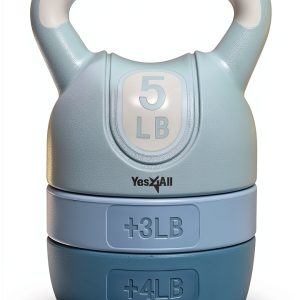
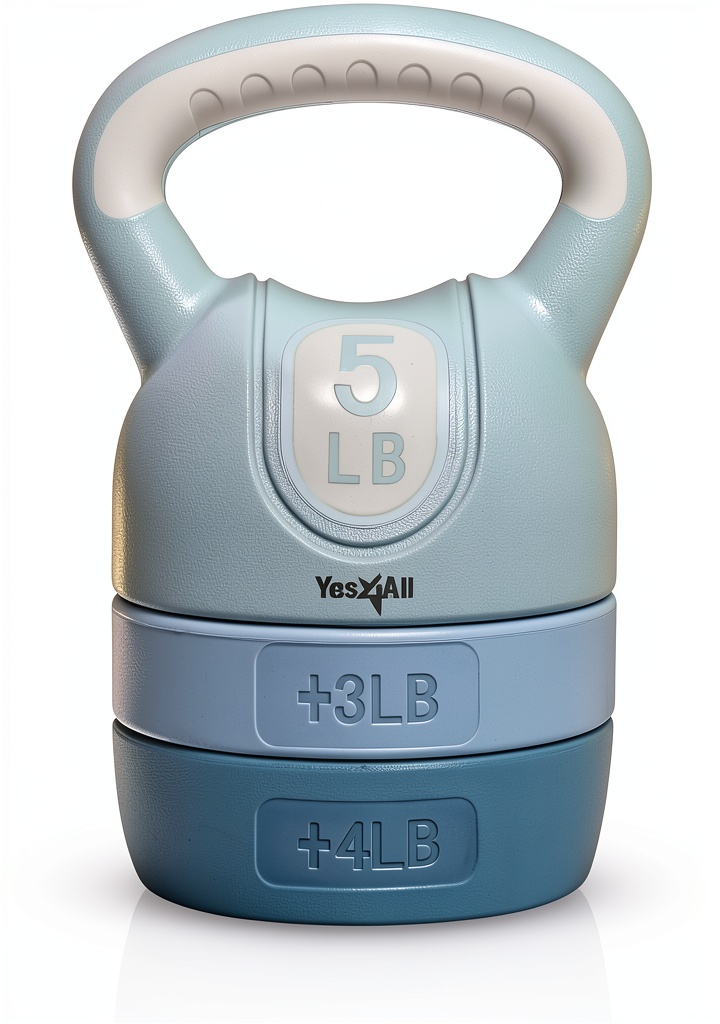
The Yes4All adjustable kettlebell takes a hybrid approach to home fitness equipment. Rather than solid cast iron, it uses a cement core encased in high-impact plastic, with additional cement plates that slot into the base to increase weight. The result is a tool that feels familiar yet different—lighter in hand but surprisingly stable during basic movements.
| Specification | Details |
|---|---|
| Weight Range | 5 lb, 8 lb, 12 lb (3 configurations) |
| Fully Loaded Weight | 12 lb |
| Dimensions | 7″ L × 6.25″ W × 10.5″ H |
| Handle Diameter | 1.2 inches |
| Construction | Cement core with plastic housing |
| Locking Mechanism | Dual-plastic twist lock |
| Color Options | Purple, Pink, Pastel, Teal |
| Warranty | 1-year limited |
The wide handle accommodates two-handed grips comfortably, making it particularly suitable for goblet squats and two-handed swings. The color-coded options add personality to your workout space, though the pastel shades show scuff marks more readily than darker finishes would.
Real-World Performance & Feature Analysis
Design & Build Quality
The plastic exterior feels substantial initially—not cheap or hollow—but experienced lifters will immediately notice the difference in density compared to cast iron. The weight distribution feels slightly bottom-heavy, which actually benefits certain exercises like goblet squats where stability matters. However, during swings, the balance difference becomes apparent; the momentum feels different than with traditional kettlebells, requiring slight technique adjustments.
The cement plates fit securely into the base, and the twist-lock mechanism demonstrates thoughtful engineering. I’ve dropped it accidentally during Turkish get-up practice (from low height), and the plates remained locked in place. That said, the plastic threading shows minor wear after three months of daily weight changes, suggesting the mechanism may need replacement eventually with heavy use.
Performance in Real Use
Where this adjustable kettlebell truly shines is in circuit training and metabolic conditioning workouts. The quick weight changes between 5, 8, and 12 pounds enable seamless transitions between exercises—something impossible with traditional kettlebells without cluttering your space with multiple bells.
During two-handed swings, the handle provides comfortable grip space, though those with larger hands might find it slightly narrow for explosive repetitions. For single-arm work like presses and cleans, the balance difference becomes more noticeable. The weight feels less “connected” to the handle compared to cast iron, creating a subtle but perceptible difference in the swing arc.
I tested it extensively in two real-life scenarios that highlight its strengths and limitations:
Scenario 1: The 15-Minute Office Workout
Keeping it under my desk, I used the 5-pound configuration for shoulder mobility work between meetings, then quickly switched to 12 pounds for goblet squats and two-handed swings during a break. The compact size and quiet operation (no clanging metal) made it ideal for this environment. The plastic construction prevented floor damage when setting it down repeatedly.
Scenario 2: Apartment Complex Circuit Training
Using all three weight configurations in a 30-minute EMOM (every minute on the minute) workout, I transitioned from light Turkish get-ups (5 lb) to moderate cleans (8 lb) to heavier squats (12 lb). The space savings were significant—equivalent to three separate kettlebells in one footprint. However, during high-rep swing sets, I missed the solid feel of cast iron, particularly as fatigue set in and form degradation made the balance differences more pronounced.
Ease of Use
Weight changes take approximately 15-20 seconds once you’re familiar with the process—significantly faster than adjusting dumbbells or other adjustable equipment. The twist-lock mechanism requires minimal force to secure, making it accessible for those with grip strength limitations or arthritis.
However, there’s a learning curve to ensuring the plates are properly seated before locking. Early in my testing, I occasionally had slight rocking because a plate wasn’t fully flush with the base. This never caused safety issues during my use but could potentially affect balance during overhead work if not addressed.
Durability & Reliability
The rust-proof construction is genuinely valuable for garage gyms, outdoor use, or humid environments. After leaving it on a patio during light rain, I simply wiped it down with no concerns about corrosion—something impossible with cast iron without regular maintenance.
The plastic housing shows scuff marks relatively easily, particularly with the lighter color options. After two months of concrete floor use, the base exhibited noticeable scratching, though this appears purely cosmetic. More importantly, the twist-lock mechanism maintained its security throughout testing, with no instances of accidental unlocking during exercises.
The cement plates themselves proved durable—no chipping or cracking despite occasional accidental drops from low heights. The plastic handle has maintained its shape without deformation, though long-term durability with heavy daily use remains uncertain beyond the 1-year warranty period.
Pros & Cons
Advantages:
- Exceptional space efficiency—replaces multiple kettlebells in one compact unit
- Rust-proof construction ideal for humid environments or outdoor use
- Quick weight changes enable versatile circuit training
- Beginner-friendly weight progression builds confidence with incremental increases
- Comfortable handle diameter works well for two-handed exercises
- Aesthetic appeal with color options suits modern home decor
Limitations:
- Limited weight ceiling (12 lb) restricts long-term progression for intermediate/advanced users
- Balance differences from traditional kettlebells require technique adjustment
- Plastic shows wear more readily than powder-coated cast iron
- Not suitable for advanced kettlebell sport techniques requiring precise balance
- Questionable long-term durability of plastic threading with frequent weight changes
Comparison & Alternatives
Cheaper Alternative: Yes4All Vinyl Kettlebells
Standard vinyl-coated cast iron kettlebells from the same brand cost approximately $20-25 for a 10-pound bell. You’re getting traditional balance and feel at lower cost, but sacrificing the adjustable functionality. Choose this if: You only need one weight, prefer traditional kettlebell feel, and want maximum durability for ballistic training.
Premium Alternative: Bowflex SelectTech Kettlebell
Priced around $180, the Bowflex offers 8-40 pounds of adjustable resistance in 2-pound increments. The weight range is substantially broader, and the balance better mimics traditional kettlebells. However, it’s significantly larger, heavier when fully loaded, and costs over five times more. Choose this if: You’re committed to kettlebell training long-term, need heavier weights for progression, and have both budget and space for premium equipment.
The Yes4All adjustable kettlebell occupies the middle ground—more versatile than single kettlebells but more affordable and compact than premium adjustable options. It represents the budget-conscious choice for space-limited beginners rather than the ultimate solution for dedicated practitioners.
Buying Guide / Who Should Buy
Best for Beginners
If you’re new to kettlebell training, this product offers an ideal introduction. The lightweight options (5-8 lb) allow technique practice without intimidation, while the progression to 12 pounds provides meaningful resistance for foundational strength building. The compact size means you can experiment without dedicating significant space to equipment you might not use long-term.
Best for Space-Constrained Environments
Apartment dwellers, office workers, and frequent travelers will appreciate the footprint savings. Being able to store what amounts to three pieces of equipment in the space of one makes kettlebell training accessible where it otherwise wouldn’t be. The rust-proof construction is particularly valuable for balcony or patio workouts where traditional equipment would deteriorate.
Not Recommended For
Avoid this kettlebell if: You regularly train with weights above 12 pounds, practice advanced kettlebell sport techniques requiring precise balance, prioritize equipment that feels identical to commercial gym options, or need equipment that will withstand decades of heavy use. The balance differences and plastic construction make it suboptimal for these use cases.
FAQ
Does it feel like a real kettlebell during swings?
It feels similar but not identical. The bottom-heavy weight distribution creates a slightly different arc, and the momentum feels less solid than cast iron. For learning technique and metabolic conditioning, it’s close enough. For advanced swing practice, traditional kettlebells perform better.
How secure is the weight lock during explosive movements?
Surprisingly secure. Throughout testing, including accidental drops from low heights, the plates never dislodged. However, I recommend checking the lock mechanism every few weeks as the plastic threading shows minor wear over time.
Can you progress beyond 12 pounds with this system?
No, the design limits you to the included weight plates. The 12-pound maximum suits beginners well but will quickly become insufficient for lower body exercises. Consider this a starter tool rather than a long-term solution.
Is the plastic housing durable enough for garage gym use?
It withstands typical use well but shows cosmetic scuffing on concrete floors. The rust-proof advantage makes it excellent for humid environments, but those prioritizing aesthetic preservation should place it on mats.
Would you recommend this over traditional kettlebells for home use?
Only if space is your primary constraint. For equal space usage, three traditional kettlebells (5, 8, 12 lb) would cost slightly more but provide better training experience. The adjustable version wins only when you literally cannot accommodate multiple bells.